
Euless Previous Residents by Era
Past residents require more than one record type. Begin with the current parcel card to establish the property, not its household. Move through the clerk's index for a chain of recorded transfers, then use the Archives and dated directory volumes for earlier address or family clues. The online deed system does not publish a complete beginning year by document class, so a missing web result is a reason to check the historical fallback, not proof that no instrument exists.
| Source | Years It Covers | Where Held | What It Shows |
|---|---|---|---|
| TAD appraisal card | Historical coverage not stated | Tarrant Appraisal District | Current owner, situs and mailing addresses, legal description |
| Official Records index | Online beginning year not stated | Tarrant County Clerk | Recorded parties, date, instrument, and legal description |
| Deed History Cards | 1876-1984 | Tarrant Tax Office | Historical property-tax and ownership research lead |
| Walls directories | 1959-2008 | Tarrant County Archives | Local-area address and household leads; check Euless scope |
| Federal census | 1790-1950 public | NARA and library databases | Household, age, and location context |
| Euless permit reports | Late 2023-2026 reports found | Euless Planning | Time-stamped project and site-address context |
Use a source for the fact it can support. A permit dates work, not occupancy. A tax or appraisal card can distinguish a property location from an owner's correspondence address. Directories and censuses may show a household but still need date and place checks. Keep a note of the source URL and the date checked beside each result.
Euless Parcel Start for Previous Residents
Confirm the parcel before looking for names. The Tarrant County Public Map Viewer can search by address, account, or owner and provides map layers and parcel context. Euless Map Atlas adds plats, survey data sheets, zoning, aerial imagery, ownership leads, and the City Limit Line Index. Map ownership is a lead only. Open the TAD detail card and copy the situs address, mailing address, account or geo-reference, current owner, subdivision, and legal description into separate fields.
The legal description is the durable bridge. A subdivision, block, lot, survey, or metes-and-bounds reference can connect records when an address is formatted differently, replatted, or affected by a city-line question. TAD is an appraisal source, not a deed and not a household census. A mailing address can belong to a different property, office, or correspondence recipient, so it cannot by itself establish who lived at the Euless address.
Address → map or TAD parcel → legal description → Official Records index → prior recorded party → archive or directory evidence.
Euless Previous Residents in Official Records
The Tarrant County Official Records Search is a free index. Search the latest conveyance with the current owner's name, seller or buyer variants, subdivision, document type, document number, or a recorded-date range. The portal separates index-only searching from index-plus-full-text OCR. Record the party spelling, document type, recording date, document number, and legal description before asking for an image or copy.
| Department | Displayed as Real Property in the inspected portal. |
|---|---|
| Search Term | Grantor, grantee, subdivision, document type, or document number. |
| Recorded Date | Two date fields for a date-range filter. |
| Index choice | Index Only or Index & Full Text where OCR is available. |
| Search modes | Quick Search and Advanced Search tabs. |
Index access and image access are different. The portal offers a watermarked image after registration or sign-in and a paid certified-copy route. In-person copies are available through Room B30, while mail requests require the document number, a self-addressed stamped envelope, and the listed payment method. The clerk does not perform title searches for researchers, so the chain must be assembled and verified one transfer at a time.
Euless Previous Residents Before 1984
Tarrant Deed History Cards provide the verified 1876-1984 bridge for historical property-tax and ownership research. When an index trail becomes older or the online scope is unclear, continue with Tarrant County Archives property ledgers, maps, and county records. Archives historic property material includes deeds, mortgages, liens, bills of sale, bonds, and land dedications in collection-specific runs. The historical land-record path is documented from 1876 forward, but the current portal's full online cutoff is not published.
The March 29, 1876 Old Courthouse fire destroyed pre-fire commissioners-court loose-paper records; pre-1876 marriage records were largely destroyed too. Later copies, transcriptions, and ledgers are useful substitutes, not a seamless original series. The Archives research room is at 200 Taylor Street, Suite 5200, Fort Worth. It welcomes walk-ins Tuesday through Friday from 9:00 a.m. to 4:30 p.m.; Monday research is by appointment. Contact archives@tarrantcountytx.gov or 817-884-3272 before visiting.
The Tarrant County historic ledgers show the archival record groups available for an older address trail.
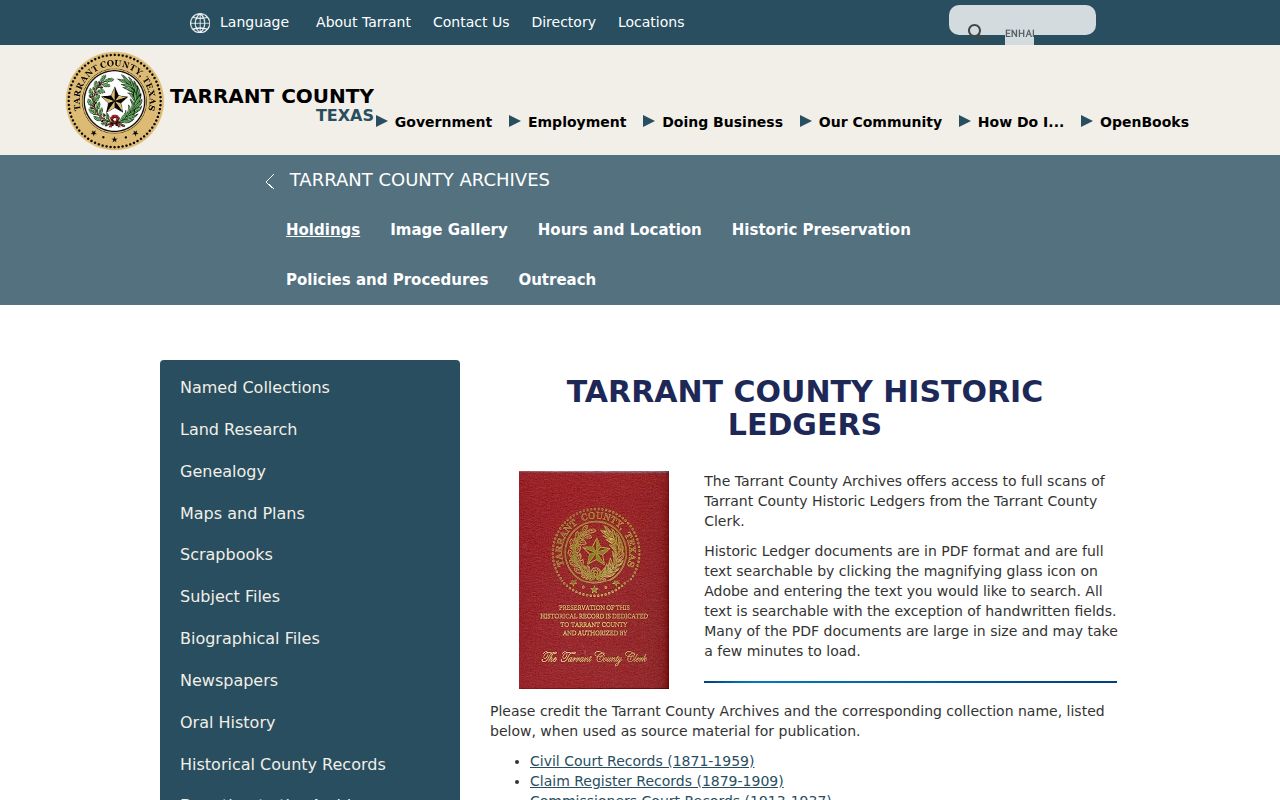
Use the ledger dates and record group as evidence boundaries, and note any gap instead of treating a missing item as a negative finding.
Euless Deed Chain for Previous Residents
A chain of title follows recorded transfers backward. Starting from the current TAD owner and legal description, locate the latest conveyance in the clerk index. Copy the buyer, seller, recording date, document number, and legal description. Then use the seller as the next grantee search subject to locate that person's earlier purchase. Trusts, estate transfers, corporate names, missing images, and an ambiguous legal description can interrupt the trail. Stop and seek the instrument or archival record when that happens.
- Save the current TAD legal description and both address fields without treating either as occupancy proof.
- Find the current owner's purchase deed in the official index and record its indexed fields.
- Search the seller as a prior grantee, using name variants, initials, and the subdivision where needed.
- Repeat backward while the legal description and recorded parties connect clearly.
- Move to Deed History Cards, historical ledgers, or the Archives when the web index ends or the land description becomes unclear.
- Grantor
- The party transferring or conveying an interest in a recorded instrument.
- Grantee
- The party receiving that recorded interest; the prior seller is commonly searched as a grantee to find an earlier purchase.
- Chain of title
- The documented sequence of recorded transfers affecting the parcel.
- Legal description
- The subdivision, lot, block, survey, or metes-and-bounds identifier that can outlast a street-address change.
Euless Previous Residents and Address Continuity
Check land, structure, title, and person continuity separately. A legal description supports land continuity; permits and certificates of occupancy can date work; deeds show recorded title parties; a directory, census, probate file, or church register may supply person context. A change in one layer does not prove a change in the others. Euless permit reports list issue date, permit number, type, site address, contractor, fees, description, and valuation. They document a project, not a household roster or a sale.
For an address that will not match, test spelling and directional variants, compare the plat and city-limit material, and search the legal description. The City Limit Line Index can help explain boundary segments. The research did not verify a local street-renumbering list or Sanborn coverage, so neither should be presumed. Use Tarrant Archives maps and confirm the actual series before asserting an older address match.
Note: The land description is often more reliable than street text when an old record uses a different municipal or neighborhood label.
Past Euless Households in Directories
Owners are only part of the address history. Walls directories offer a 1959-2008 local-area spine, subject to confirming Euless in each volume. Start with the address in a reverse or criss-cross section if the volume has one, then verify the occupant in its alphabetical section. Pair each dated listing with the nearest public federal census, the latest of which is 1950 under the 72-year rule. A directory entry is an interval of evidence, not proof that a person remained at the address throughout the year.
The historical collections themselves are described in the Euless city directory collections. Use them here to test one address trail, not to turn an uncertain listing into a complete household history. No Euless-wide official obituary index was identified. Funeral-home archives, church bulletins, cemetery material, probate files, and Archives collections may provide endpoints, but each needs its own custodian and date check.
Euless Previous Residents in Walls Volumes
The Walls, Tina collection combines city directories from 1959-2008 with Hurst-Euless-Bedford maps from 1974 and 1976. Those maps can help separate an address change from a boundary or street-context problem. The collection page does not enumerate every city in every directory, so the responsible request is simple: ask which volumes include Euless and whether a reverse section exists for the target year.
The Walls collection at Tarrant County Archives identifies the directory and map materials available for the address-history search.
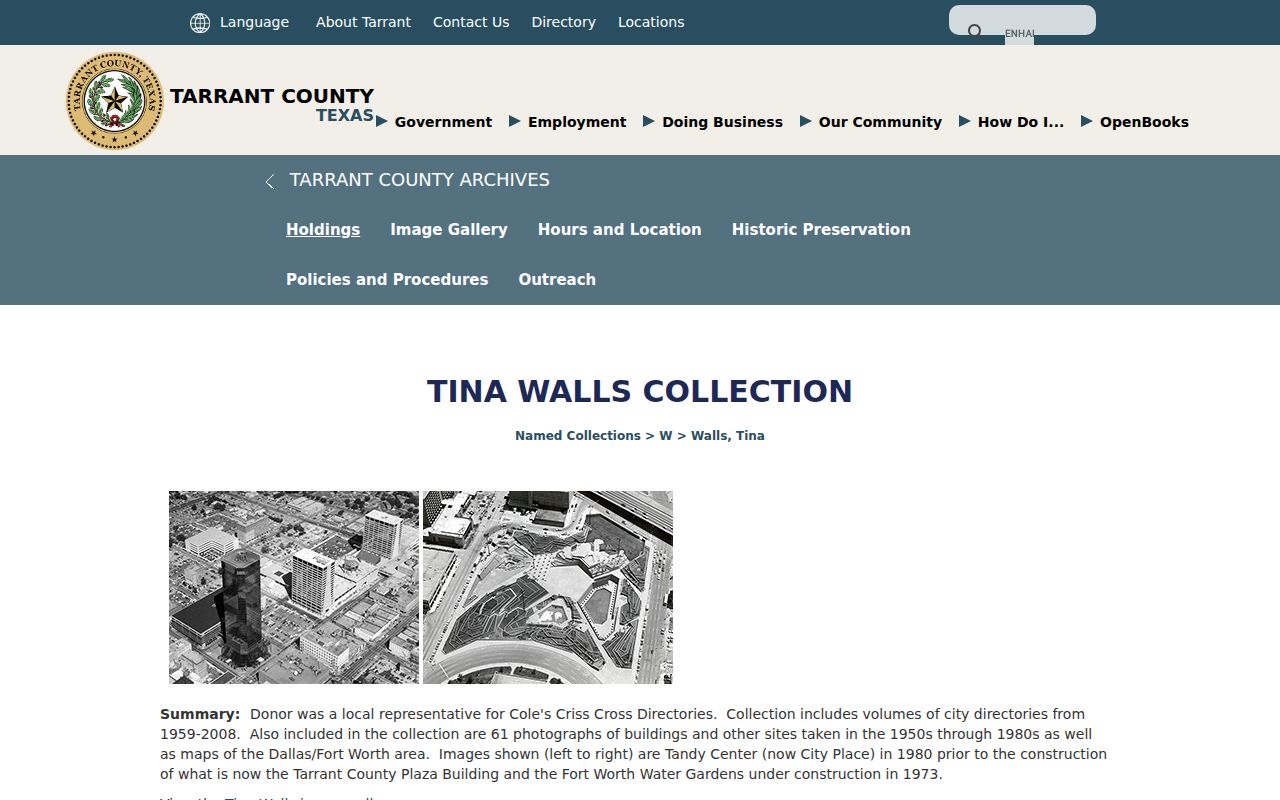
Checking the physical or archival volume is essential because a collection-wide date range does not guarantee city coverage or an address-ordered section.
Euless Previous Residents and Family Registers
The Fuller collection can add family evidence between dated address records. First United Methodist Euless member records span 1879-1942; its marriage register runs 1883-1913, and infant baptisms run 1887-1913. Membership, marriage, baptism, withdrawal, and death notes can distinguish people with similar names, but church membership is not a current-residency certificate. The Cannon collection adds Euless business records from 1938-1963 and broader community and family material from 1881-2022.
Euless Public Library's Legacy Lab supports preservation and organization of family papers, while the library's UNT partner collection provides dated local photographs, letters, postcards, and clippings. A family paper can supply a date, place, or name worth testing against a deed, map, ledger, or directory. Preserve the original wording and record where it came from.
Euless Previous Residents and Fraud Alerts
Tarrant County Property Fraud Alert is a free name-based service that monitors an exact grantor or grantee name across more than 90 document types and sends an alert. It cannot prevent a fraudulent filing. It is useful for monitoring a recorded-name issue, but it is not a title search and does not identify who occupies an Euless address.
| Free index hit | Points to a recorded item that still needs source and image verification. |
|---|---|
| Certified copy | Provides a custodian-issued record through the county's paid copy route. |
| Archives visit | Supplies historical books, ledgers, maps, and collection context when online access is incomplete. |
| Fraud alert | Monitors an exact recorded name; it does not block a filing or prove occupancy. |
The Property Fraud Alert page explains the county service and its limits.
Use an alert as a prompt to review the official instrument, then keep the chain of evidence tied to the parcel and recorded date.